New Hampshire’s Home Education Law Completely Rewritten as of July 2026
New Hampshire’s home education law, RSA 193-A, was entirely rewritten by the enactment of HB 1268 that went into effect as of July 1, 2026.
Among the changes, HB 1268 removed the former requirements for routine notification, portfolios, and annual evaluations. Families have the option regarding any and all documentation they maintain for their own purposes.
GSHE has an important summary of these changes available here.
When Is Declaration Required?
Under the revised law, home education has conditional notification based on a child’s enrollment status.
A declaration is required:
- IF withdrawing your child from a public school → THEN submit a simple declaration (child’s name, DOB, address, parent signature).
- IF wanting access to public school curricular or cocurricular programs under RSA 193:1-c (Equal Access) → THEN submit a simple declaration.
There is no other statutory requirement or process for notifying the state, a school district, or a private school that a family is home educating.
The new law does not require families to maintain or submit portfolios, evaluations, assessments, or other academic records as part of home education.
What Does GSHE Recommend?
GSHE recommends home education families keep good records of your child’s academic progress—not because New Hampshire’s home education law requires them, but because they can be useful.
There is no single right way to document a child’s education. Keep records in whatever form best reflects your child’s work and your family’s approach to home education.
That might include:
- evaluations or assessments, if you choose to use them
- samples of your child’s work
- reading lists
- course or curriculum information
- project descriptions
- records of participation in programs and activities
- notes about subjects or areas of study
- an annual summary or reflection on your child’s growth and learning
You do not need to create a formal portfolio simply to satisfy New Hampshire’s home education law.
Nevertheless, maintaining some records can be a practical safeguard. They may be useful later when applying for programs or educational opportunities, creating a transcript, enrolling in another educational setting, documenting a child’s educational history, or answering questions about what your child has accomplished.
It is generally much easier to maintain a reasonable record as you go than to reconstruct several years of education later.
GSHE has two additional resources on keeping good records: Why Recordkeeping Still Matters and Reflections of Growth.
And yes, this documentation may be helpful if a family encounters questions from government authorities regarding a child’s educational enrollment status.
Notarized Self-Declaration
GSHE also recommends that families consider creating a notarized self-declaration when beginning a home education program.
This is a voluntary document that the family creates and retains for its own records. It is not the same as the statutory declaration required in the limited circumstances described above, and it is not filed with a school district, the Department of Education, or another government agency.
Think of it as a personal legal record, similar in concept to other important documents families create and retain for themselves—such as a power of attorney, health care directive, or will. These documents are valuable not because a government agency routinely collects them, but because they establish a person’s wishes or circumstances and can provide important evidence if questions arise later.
The document can be very simple:
I am home educating my child, [child’s full name], born [date of birth], beginning [date].
My home address is [address].
[Parent’s name and signature]
Take the document to a notary and sign it in the notary’s presence with a form of identification as prescribed in NH law. Notary services are often available through banks, town offices, and some UPS locations for $10 or less.
Keep the completed document in a secure location with your other important records.
Identification Requirements
New Hampshire law provides more than one way for a notary to establish a signer’s identity.
RSA 456-B:2-b permits identification through current government-issued identification or through the verification upon oath or affirmation of a credible witness who personally appears before the notary and meets the statutory requirements.
The notarized document is created and retained by the family. Notarization does not mean that the document is submitted to a government agency or entered into a government database.
Why Create a Notarized Self-Declaration?
Because something that is simple and inexpensive to create today could be valuable later.
A notarized self-declaration provides a dated, independently witnessed record that you were home educating your child beginning on a particular date. It could be useful if questions ever arise about enrollment, educational history, or the timing of your home education program.
It also gives families a way to establish their own record of their educational status without creating a government filing requirement.
The goal is not to recreate the paperwork that New Hampshire’s new law eliminated. The goal is to encourage families to keep documentation that is genuinely useful to them.
GSHE Empowers Parents
GSHE has consistently and faithfully made these same recommendations to legislators throughout the origins and discussions surrounding HB 1268.
Including an optional notarized self-declaration in law would have mandated that government officials recognize and accept it as a positive affirmative defense in enrollment, truancy, or educational neglect investigations.
Because it is not in statute, the best we can offer is a recommendation and hope that it will be sufficient evidence for intent and objective documentation of a home education program.
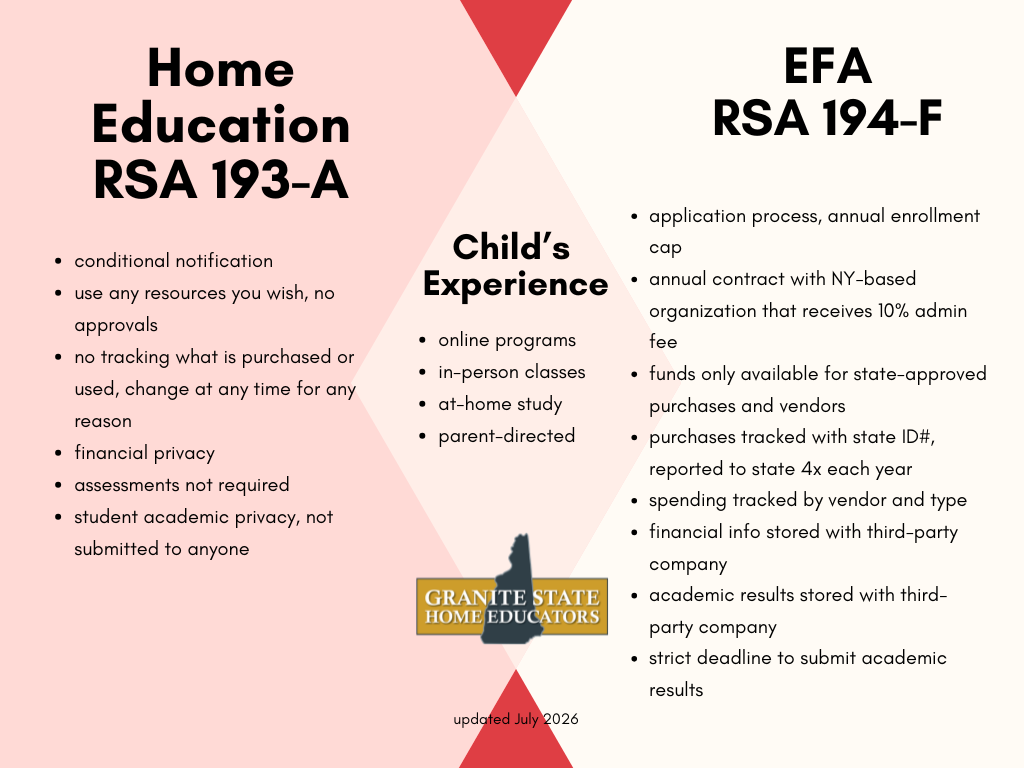
Home Education Is Not the EFA
Another important distinction is between home education and the Education Freedom Account (EFA) program.
The law now explicitly defines a “home educated student” in RSA 193-A as a student receiving an education provided, coordinated, or directed by a parent and specifically excludes a student participating in the Education Freedom Account (EFA) program established in RSA 194-F.
This distinction matters because homeschooling with an EFA is not the same as independently home educating under RSA 193-A.
Homeschooling is a generic term, used nowhere in state law. In contrast, home education is defined in RSA 193-A. The EFA’s eligible education uses, as defined in RSA 194-F, includes parent-directed learning and private school tuition, among other purposes.
A family that is homeschooling with an EFA has affirmatively applied to participate in the EFA program, been approved for an EFA, entered into a signed contract with the scholarship organization, and is receiving state education funding through that program. The family’s requirements are therefore defined by RSA 194-F, not by the requirements applicable to an independently home educating family under RSA 193-A. This is not an ambiguous or “hybrid” educational pathway.
GSHE has a Venn diagram to help distinguish between independent home education and the EFA.
If your family is independently home educating under RSA 193-A, EFA requirements do not apply to you.
If your family participates in the EFA program, the requirements of RSA 194-F and your EFA agreement apply.
If you are an EFA family and unclear on the expectations, contact the managing scholarship organization for more information and assistance.
Summary
What the law requires: A statutory declaration when withdrawing a child from public school or when seeking access to public-school curricular or cocurricular programs under RSA 193:1-c.
What the law does not require for independent home education: Routine notification, maintaining academic records or portfolios, or completing any kind of annual evaluations or assessments.
What GSHE recommends: Keep reasonable records of your child’s educational progress in whatever form best reflects your family’s home education experience. GSHE also recommends creating a simple notarized self-declaration when beginning home education and keeping it with your important family records.
Home Education and the EFA are separate pathways: A family independently home educating under RSA 193-A is not subject to the EFA requirements. A family participating in the EFA program is subject to the requirements of RSA 194-F and its EFA agreement.
Additional Resources
Summary of the changes by HB 1268
Why Recordkeeping Still Matters
NH Department of Education technical advisory
Note: the NH state website is not updated to reflect changes to RSA 193-A at this time.