
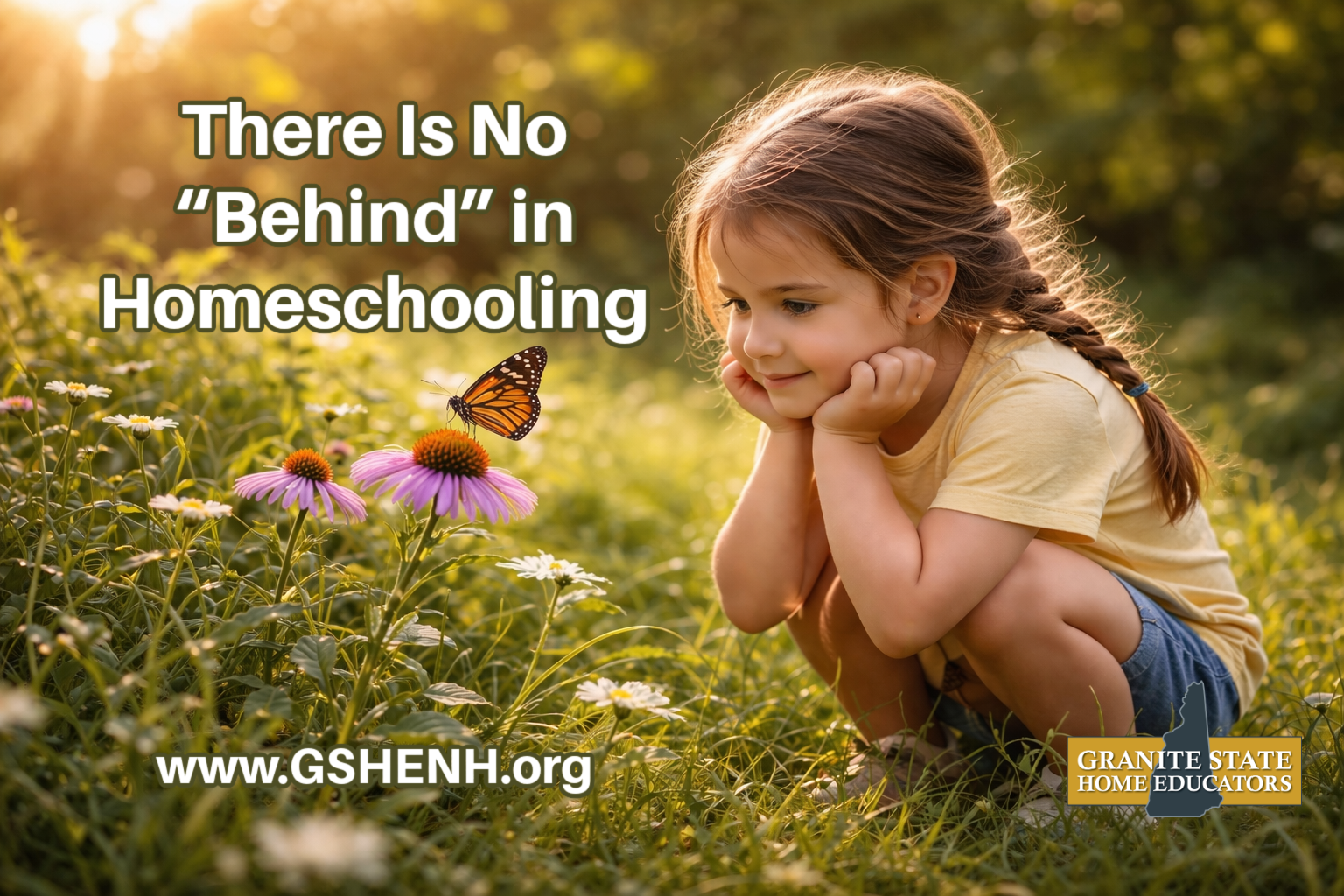
Letting Go of Comparison and Trusting Your Child’s Path
At some point, many homeschooling parents find themselves wondering if their child is “behind.”
It usually doesn’t start as a strong belief. It’s more of a quiet question that works its way in over time—after a conversation with a friend, a comment from a relative, or simply noticing what other children the same age seem to be doing. A child who isn’t reading yet. A math concept that hasn’t quite clicked. A sense that things aren’t moving as quickly as expected.
And underneath all of that is often a deeper concern: Am I doing enough?
That question deserves to be taken seriously. But the idea of being “behind” needs to be looked at much more carefully, because it comes from a framework that doesn’t really apply to home education.
The concept of “behind” only makes sense if there is a single, fixed timeline that all children are expected to follow. It assumes that learning happens in the same order, at the same pace, for everyone. That’s the structure used in institutional settings, where standardization is necessary to manage large groups of students. But it has never been an accurate reflection of how children actually learn.
Even in the earliest stages of development, children do not follow identical timelines. Some walk early, others later. Some talk quickly, others take their time. We don’t look at a toddler who walks at fifteen months and assume something is wrong simply because another child walked at nine. We understand that development varies, and that variation is normal.
That same truth continues into the years we label as “academic,” even though we tend to forget it.
Learning to read, developing mathematical understanding, writing clearly, thinking critically—these are not skills that unfold on a universal schedule. Some children read early and easily, while others need more time but go on to read deeply and fluently. Some grasp math concepts quickly, while others need repetition or a different approach before things make sense. Some move steadily across subjects, while others focus intensely on one area while other skills develop more gradually in the background.
None of that is evidence that a child is falling behind. It is simply evidence that they are developing along their own path.
The feeling of being “behind” almost always comes from comparison. It comes from placing a child’s progress next to someone else’s and assuming those two paths should look the same. It comes from questions about grade levels, or casual observations about what other children are doing, or well-meaning concerns from people who are used to thinking in terms of standardized expectations.
Once comparison enters the picture, it quietly changes how you see your own child. Instead of noticing growth over time, it becomes easy to focus on what hasn’t happened yet. Instead of seeing progress, you start seeing gaps.
And that shift in perspective can create doubt where it doesn’t belong.
The more useful question is not whether a child is keeping pace with others, but whether they are learning, growing, and moving forward over time. Growth is not always steady, and it is not always obvious in the moment. Children often move through periods where progress seems slow or even stalled, only to make significant gains later when understanding begins to come together.
From the outside, those quieter periods can look like a lack of progress. From the inside, they are often a necessary part of how learning takes shape.
One of the strengths of home education is that it allows for this kind of development. You are not required to move on before your child is ready, and you are not held back when they are ready to move ahead. You can spend more time where it’s needed, adjust your approach, or follow an interest that leads to deeper understanding. The pace can change because the goal is not to stay on schedule—it is to support real learning.
There are, of course, times when a parent should pause and take a closer look. If a child is consistently frustrated, not making progress over an extended period, or something simply doesn’t feel right, it makes sense to adjust your approach or seek additional support. That kind of attentiveness is part of being responsive to your child.
But that is very different from assuming a child is behind simply because they are not matching someone else’s timeline.
Those are two separate things, and it’s important not to confuse them.
Part of home education is learning to hold your perspective steady, even when outside expectations try to pull you in a different direction. Well-meaning friends or family members may ask questions or make comments based on what they know from school settings. Those questions can linger longer than they should if you allow them to reshape how you view your child’s progress.
But you have something they do not—you see your child over time. You see what they understand, what they’re working through, what interests them, and how they are growing, even when that growth isn’t obvious to anyone else.
That long view matters more than any comparison.
There is no universal timeline that determines when a child is “on track.” There is only your child—their development, their readiness, their interests, and the path they are moving along.
When you begin to look at learning this way, the idea of being “behind” starts to fall away. Not because you are lowering expectations, but because you are replacing an inaccurate standard with a more meaningful one.
Your child is not falling short of where they should be.
They are learning in the way that is appropriate for them, at a pace that reflects who they are.
And that is exactly what home education is meant to support.
